Saturday, 5 July 2014

Trilby Station - 4 July 2014

We decided on a relaxing day today. When we checked in yesterday, Liz gave us a folder with the history of Trilby Station and some interesting information on Louth. It made for a fascinating read.

Liz and Gary Murray, her husband, have lived at Trilby since they married in 1981. They have 4 children, the eldest being 30. Gary is a fifth generation Murray who settled on the Darling River in 1860. Liz first came to the area as a Jilleroo/Governess in 1978 and never left. 3 of their children have left home and the youngest is in his last year of school.

Liz loves adventure travel. She hiked the Kokoda Track in 2009. In 2011 she spent a month in Africa - 2 weeks living with a local family in a fishing village in Senegal, where there were no tourists and no English speakers. From the village she then went to Tanzania and climbed Mt Kilimanjaro, before doing a week's safari around the Serengeti area. In 2012 Liz walked the Larapinta Trail from Alice Springs. In 2013 she and her daughter, Alex, went to Morocco for 2 weeks, followed by 3 weeks in Senegal with the family she had spent time with in 2011. At the end of this year she will spend 2 weeks hiking in the Simien Mountains of Ethiopia and back to the family in Senegal for 2 weeks. Liz is certainly an amazing woman. She has home-schooled their 4 children till they went away to boarding school for high school, as well as running the property. And now they have people staying here, which she manages in conjunction with continuing to run the property.

They currently have around 16,000 merino sheep, down 4,000 from last year. Shearing begins in mid May for about a month. They got around 400 bales of wool, a bale weighing around 186kg (about 32 grown sheep) and they hoped to achieve $1,200 per bale.

Shearing shed near homestead - one of 4 on property
 
It costs around $12/sheep to shear. $7 goes to contractor (he brings 6 shearers, shed hands, woolpresser, wool classer, pen-er-uppers (person who pens the sheep), cook and all groceries. Trilby provide clean bed with mattress cover and pillow per shearer and a clean set of quarters. The shearers move from shed to shed on the property. Women are also on shearing teams these days - as roustabouts, cooks and occasionally shearers.
 
The 4 kids were all capable of driving on their own by age 7 and were given a small motorbike at about 3 to begin helping with mustering. On outgrowing that, they moved straight to the 4 wheeler motorbike. By age 5 they were towing a trailer behind the bike and could reverse it without any trouble.
 
Enough about the family for the moment. I cooked a slice this morning. It was a yummy Cranberry, Banana and Walnut slice. It turned out well. I also got some sewing done.
 
After afternoon tea, we went for another walk on the property. Saw a good size Red Kangaroo. It is a lovely property to walk around in the vicinity of the river.


Thursday, 3 July 2014

Bourke to Trilby Station - 3 July 204

A very cold morning in Bourke to say goodbye to us. We have really enjoyed our time here and could probably have had another day or two. We would have liked to go out to Mt Oxley and also to Brewarrina, which is only about 90 kms away. No doubt we will be this way again at some stage.

We took the road to Louth which follows the Darling River. You don't actually see the river, although it comes close to the road in a couple of places. There are 2 roads which follow the River, one on the east side and one on the west. We were told the east was better and it was pretty good, except for a few corrugates in places in the last 20 kms. The land is very flat around the area. We were told in our tour of Bourke the other day that the fall of land in the area is 9 inches per mile, so not very much at all.
We saw a fox and crows sharing a feed of a roo killed by a car. The fox didn't look in the best shape. We also saw a few wedgetail eagles.

Our morning tea stop was at the end point for Captain Sturt and Hamilton Hume's 1829 expedition in the area. Our stop was on Hume Creek. Thomas Mitchell was also in this area. Sharing their footsteps, although in much more comfort!

Louth was a very small village on the Darling River and is where we needed to cross to the west side of the river. I certainly wouldn't like to play cricket or football on their oval. Pretty hard ground with you might as well say no grass. Diesel is $1.90/litre. Luckily we didn't need any.

Our destination was about 30 kms from Louth - Trilby Station. It is a property of 360,000 acres. There are 5 powered sites and about 15 or so unpowered sites along the river. When we rang the other day to enquire there weren't any powered sites left, but when we arrived they had one. We drove along the unpowered sites to check them out before deciding. The unpowered sites were quite heavily shaded for the most part, so we decided to take a powered site.
The afternoon was beautiful, even warm and we ended up in t-shirts. We went for a long walk following the road round the unpowered sites for a few kms and enjoyed the opportunity to have a really good walk through the bush. We saw red kangaroos and budgies, as well as pelicans on the river. The river banks are very deep and steep with not as much water as round Bourke. It was hard to imagine that Trilby Station floods and sometimes the homestead is isolated for months at a time.

There is a fishing group staying here in the Shearer's Quarters. They are from the Riverina area. There were 12 men originally and they were quite noisy round the camp fire last night before we got here. 7 of them left this morning with the rest leaving tomorrow. I spoke to one of the men this afternoon. He said they haven't caught a thing even in their boats. There is not enough water.

There a group of 3 families next to us. They are from Brisbane. One of the guys came in to tell us late last night to tell us a fox had just got into the front of their tent where they store their food. We stood outside with him as a couple from their group followed the fox by the light of a torch. We could see it, and it certainly wasn't keen to move away. The stars at night out here are just beautiful. Crystal clear.


Bourke - 2 July 2014

It is our last day in Bourke today. On Monday, we had ordered some meat at Willoughby's Butchery. They were going to cryovac the meat free of charge and have it ready for us to pick up this morning. We had morning tea at Grubby Mick's Café first, which wasn't too bad, did some grocery shopping and picked up the meat before heading back to the van.

After lunch we did a tour with Mateship Country Tours around Bourke and to a couple of places just out of Bourke. It was a great tour with Stu. He has been running the tours for the last 19 years, and is also a Councillor on the local Council. His father started Hungerford Hill Wines in the Upper Hunter Valley. Stu is very passionate about Bourke.

We drove around Bourke first, with some of the lovely old buildings being pointed out, including the fact that there are 2 Court Houses in town! The authorities didn't realise there was already one built, so they made the second one a Maritime Court. Stu did say that Bourke is improving and that some of the shops have started taking the grills down from the front of the buildings.

From being such a huge rail depot and moving so much wool, the last train left Bourke in 1989.

Stu also talked a bit about the Darling. It plays such a big part in the life of the town. Bourke suffered through 6 floods in 3 years. Enough water flowed down the Darling in those floods to fill 25 Sydney Harbours. When there are floods in Queensland, it takes about 8 weeks to reach Bourke. The river flows 5 kms/hour even in flood. It just spreads out over the land instead. 26 rivers flow into the Darling. There are 75% of primary producers reside in the Murray Darling basin and you really need 100,000 acres to support yourself. A water licence costs $1.6 million which gives you a 400 acre licence - 2000 megalitres.

European carp is causing lots of problems for our rivers, and the Darling is no different. The carp eat away the vegetation along the edge of the rivers which cause the banks to collapse. One of the fishing clubs caught 2.5 tonne of European carp in a weekend, in an effort to reduce their numbers. Native fish are slowly being reintroduced. You are no longer allowed to remove snags from rivers as they are habitats for the fish.

We then went out of town to a navel orange orchard. The orchard was started by a Russell Mansell on 40 acres. He built it up to a big concern, borrowed money during the drought and then the Government in a deal with the Greens a few years ago, took away his water rights. He ended up in financial difficulties (at age 69) and the bank took over the farm. With Woolies and Coles and their lack of regard for Australian farmers and screwing them down on price, the new owners are going to plough in the orange trees. They also used to grow table grapes on the property. They were ploughed in. They then tried rockmelons. Unfortunately, they were only paid 12.5 cents for each rockmelon, so they were ploughed in. Before we know it, all our food will have to be imported.

With the trees going to be ploughed in, we were given a plastic bag each and told to fill it with the oranges from the trees. We did, with mixed feelings.


Leaving the orchard we then visited a cotton gin. It was supposed to be working, but unfortunately the machine had broken down. We still did a tour through it and we thoroughly enjoyed it.

Cotton is a desert plant and gives a better return than fruit. You only need to water cotton for 48 hours and this is sufficient for the whole year. They have a long tap root. It is planted in October and picked March - May. No chemicals are used.
The above is cotton seed and is used in the production of different foods, e.g. oils.

Stu showed us a film of the machinery used to harvest the cotton. It can do 600-700 bales a day, wrapping it in a plastic film before spitting it out.
Once the bale of cotton goes into the gin, it only takes 90 seconds for it to go through the process.

Monday, 30 June 2014

Bourke - 1 July 2014

It was -1 degree this morning. A chilly night. It took me a little while to get going this morning. It ended up being a warmer day than we have had the last few days, and most importantly, the winds had dropped right off.

We went to the Outback Show at the Exhibition Centre this morning. It was a show using camels, horses, dogs and bullocks. It was a great show and the animals were great - very clever. The fellow putting them through their paces was a bit of a comedian and it made for a very entertaining show.
He mentioned during the course of the show that an IPad was being given away and that you needed to pay attention during the Show. Anyway at the end of the Show, he asked what his daughter's name was. I piped up with the answer. I wondered what I was going to get, expecting a picture of an IPad. He went over to a box and came over to me and handed me a packaged sterile eye pad! We all burst out laughing. Very clever. I knew it would not be a real IPad!

We drove into town and had some lunch before going for a walk looking at some of the old buildings. The Lands Department building is lovely.
From town, we drove out to the old Lock and Weir, a few k's out of town. It was built in 1897 and is the only one of its kind built on the Darling River. They were going to build about 40 of them, but the rest never eventuated.

Bourke - 30 June 2014

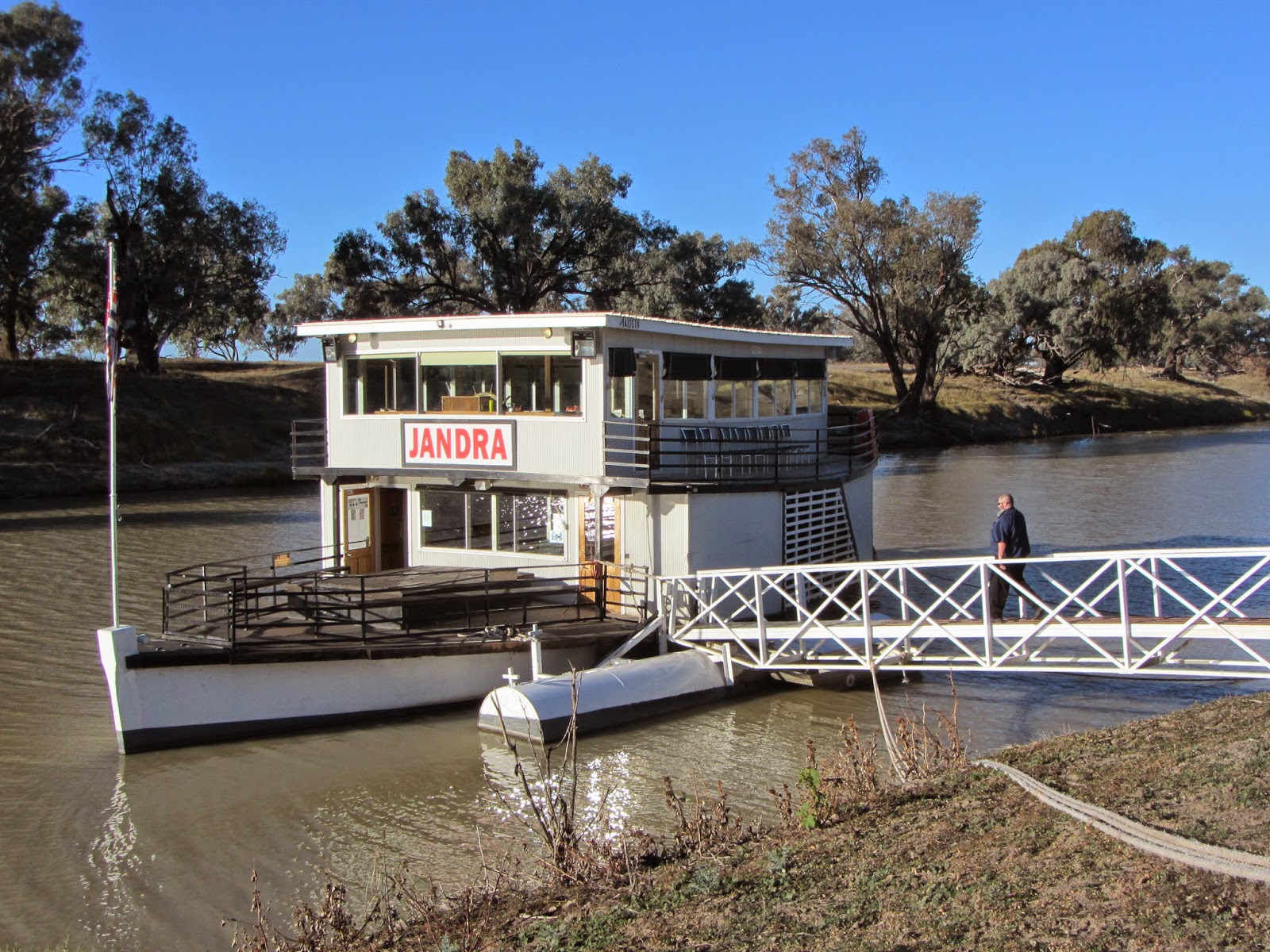
We boarded the PV Jandra at 9 this morning to do an hour long cruise on the Darling River. It was a great trip, with lots of information passed on about the river. Where we were tied up at the bank before leaving, there is a telegraph pole. At the top is a marker which is where the flood of 2011 came to. Just below is there was another marker for the flood of 2012. Quite amazing.

The paddleboat only needs half a metre of water under it. The Darling River in this area has a good amount of water in it. It starts near Brewarrina, which is not far from Bourke. The river is lined with Red River Gums, just magnificent shaped trees.
With all the twists and turns in the Darling River, it actually travels 3 times the distance you would travel in a straight line. In the late 1800's, Bourke was the largest inland port in the world for exporting wool, shipping over 40,000 bales down the Darling each year. Hard to imagine now. There were over 2 million sheep then, now there are only about 200,000. The peak price for wool was in 1952 when the farmers got 1 Pound (money) for 1 pound (weight) of wool.

The trip on the Darling was certainly worth doing. We thoroughly enjoyed it.

After lunch we went to the Back o' Bourke Exhibition Centre, which is attached to the Information Centre. There is also a Artesian Bore in the grounds. Through a series of interactive displays, spread over a couple of buildings, you are taken on a journey to learn about the people and history of the area. It was excellent. The ticket entitles you to 2 days entry.
A number of people featured in the display. Henry Lawson was sent out to Bourke by his editor when at The Bulletin, with 5 Pounds and a train ticket, to get him away from the Pubs in the Rocks area of Sydney and also to provide him with some new inspiration. At the time Bourke had 28 pubs! It now only has 1.

C.E.W. Bean, the war historian, was featured as he spent quite a bit of time round Bourke. Breaker Morant was a drover round Bourke, and a friend of Henry Lawson. Sydney Kidman's drovers used to rest their stock between his stations and the markets at the site where we are staying. Fred Hollows was also featured and spent quite a bit of time in Bourke. He loved it and is buried here in Bourke.

From the Centre, we headed to the Cemetery to have a look. I love wandering round old cemeteries. Fred Hollows figures very prominently here.
We headed into the town after this. Bourke apparently has the worst crime rate per capita in Australia. With the way the shops are boarded, that says there is some truth in that. We had a walk around. It is not really a pleasant place to walk around. There are roller doors over the shops and some of them only have an opening up for the door, which is then pulled down when it closes for the night. This is the newsagency.
The winds continued today. It was cooler earlier tonight and we had the heater on in the van by 5 o'clock. It is only supposed to be 1 degrees in the morning. See how it goes.

Sunday, 29 June 2014

Bourke - 29 June 2014

Didn't hear any trucks during the night. It was very quiet. Unfortunately, even though it wasn't too windy when we got up, although a bit chilly, the wind got up again during the day. Very unpleasant.

We had a very relaxing morning. I did some washing and we just sat by the van. I even did some patchwork, the first time since we left. Kidman's Camp is by the Darling River, although I did think it was right on the river. The river is 500 metres past the Park, so we walked down to have a look before lunch. The PV Jandra Paddleboat is moored there and we will board it for a ride on the river one of the days we are here. While we were out there we spotted a goose wandering hanging around near the garbage bins. He didn't attack us thank heavens.

Bruce worked out our mileage while we were relaxing at the van. So far our fuel consumption has averaged out at 12.5L/100km, which is excellent. The bigger vans would use 20 Litres or more/100kms. On a few of those days we have been driving into the wind too which would have eaten the fuel.

After lunch, we headed towards town to pick up some information. We passed a lime farm. Bruce has brought limes from our tree at home which he has been using. After that, we had to cross the Darling River. The old wooden bridge is still there although not in use. Next to it is the new bridge, called The Gateway Bridge. No comparison to the Gateway Bridge in Brisbane! It's because Bourke is the Gateway to the NSW Outback.
The girl at the Information Centre, which is at the Back O' Bourke Exhibition Centre, was very helpful. We ended up booking a package of 4 different events/tours, which we will do while we are here. It was cheaper to book the package by $10 each. The Centre looks very impressive and we will have a look through the rest of it another day. That is included in our package ticket.

We had a drive through town and being Sunday, it was very quiet and most things were well and truly boarded up. We will be interested to have a look through town during the week to see how different it is. There was a big gathering of Aboriginals at one of the halls, at some sort of function. With everything being boarded up, it was hard to see what sort of shops there are. We didn't even see a take away food shop, not that we were interested for ourselves.

Leaving town behind, we drove out the other side to have a look at where the explorer, Thomas Mitchell set up Fort Bourke Stockade about 35km down river from Bourke in 1835. It was built to hold 6 men while the rest of his exploration party continued to explore down river. It was the only Fort ever built by Australian explorers. Imagine being stuck in something that size with 5 other people for however long they were.
The road into the Stockade/Fort was a very narrow dirt road with many holes. It was quite interesting to read the information about Mitchell. He accomplished so much. He was a workaholic, but certainly opened up the area. He was Surveyor General of NSW for 27 years, taking over from John Oxley.

We had booked to go to Poetry on a Plate tonight, held at Kidman's Camp. There was a meal (slow cooked beef casserole and a veg and lentil dish) provided, along with dessert. While that was happening Andrew Hull recited poetry. This was held under the stars with campfires spread round the area. There was one big campfire in the centre and smaller ones round the outside. Luckily the wind died a bit tonight although we did get a few sprinkles. It was a great night. One of the people next to us described Andrew as a thinking man's poet. He was very good, reciting his poems of the area and the history. It was a great night.


Saturday, 28 June 2014

Yowah to Bourke - 28 June 2014

Yowah is certainly an interesting place. A very mini Lightning Ridge in a way, and maybe the opal mining towns all have this same fascination. The characters that live and stay there are no doubt what gives the places this fascination. It would have been good to have a couple more days there but there will be another time.

We managed to get away a bit earlier than we have been doing as we had a longer drive today to Bourke today. Our journey would take us back through Eulo and Cunnamulla before heading across the NSW border and on to Bourke.

Our elderly next door neighbour, Don, had always wanted to see a red kangaroo in the wild, and he and Audrey did quite a bit of travelling and fossicking a few years ago. Bruce and I were hoping to get a good photo of a red kangaroo to send to him, but the only ones we have seen are road kill. There is still time.

As we came in to Eulo we saw a sign advising that Eulo is Lizard Country and that the population is 50 people and 1,500 lizards. Eulo is a nice little place.

We stopped at Cunnamulla for morning tea, fuel and supplies. We paid another visit to the café in the centre of town, which was doing a good business. For anyone travelling through Cunnamulla, it is just across from the fountain memorial to the fallen Diggers. A great little café.

Heading south , we went through some rain about 40 km north of the border. But the worst thing was the wind. As the day went on, the wind was getting stronger and stronger. There was even tumbleweed blowing across the road. We were glad we didn't get hit by this one.
At the border is a little settlement called Barringun. It consists of a roadhouse and a pub. We had heard about the lady who runs the pub, a lady 90+. We wanted to stop and have a chat to her. When we went in she was sitting on a chair with a blanket over her. We were her only customers - Bruce bought a couple of stubbies for tonight. Her name was Mary and she was an interesting character and would no doubt have many stories to tell. She was lovely to chat to and had a lovely smile.

As you can see, it is quite an old pub. Mary follows Queensland in the State of Origin. She reckons NSW are bad sports.

We pulled in to Kidman's Camp, a Caravan Park about 8 km north of Bourke. Quite a few people advised us not to stay in Bourke itself. Apparently there can be a bit of trouble in town. Kidman's doesn't take pets either, which suited us, whereas the Caravan Park in town does. It is on the highway with quite a few trucks driving past, but hopefully they will die down during the night. Kidman's is $32 a night for a powered site. It was still blowing a gale when we arrived but during the night it died down a bit.