It was a cold morning with the temperature below zero, but it was quite warm later in the day till the wind picked up late in the day.
We had a good walk round part of White Cliffs this morning. It is very spread out over a few kilometres.
We walked up past the sports club. The fields are named after Bill O'Reilly, the Australian cricketer, who played at the time of Bradman I think. He was born in White Cliffs. It was an uninspiring field, quite desolate and stony, as was the golf course which we went past later.
In 1981 a Solar Power Station was built as an experimental facility by the Australian National University. It consisted of 14 sun tracking dishes and supplied, for a fee, to the local hospital, school, post office and 12 residences. As a result it was the first commercial solar power station in the world. It closed in 2005.
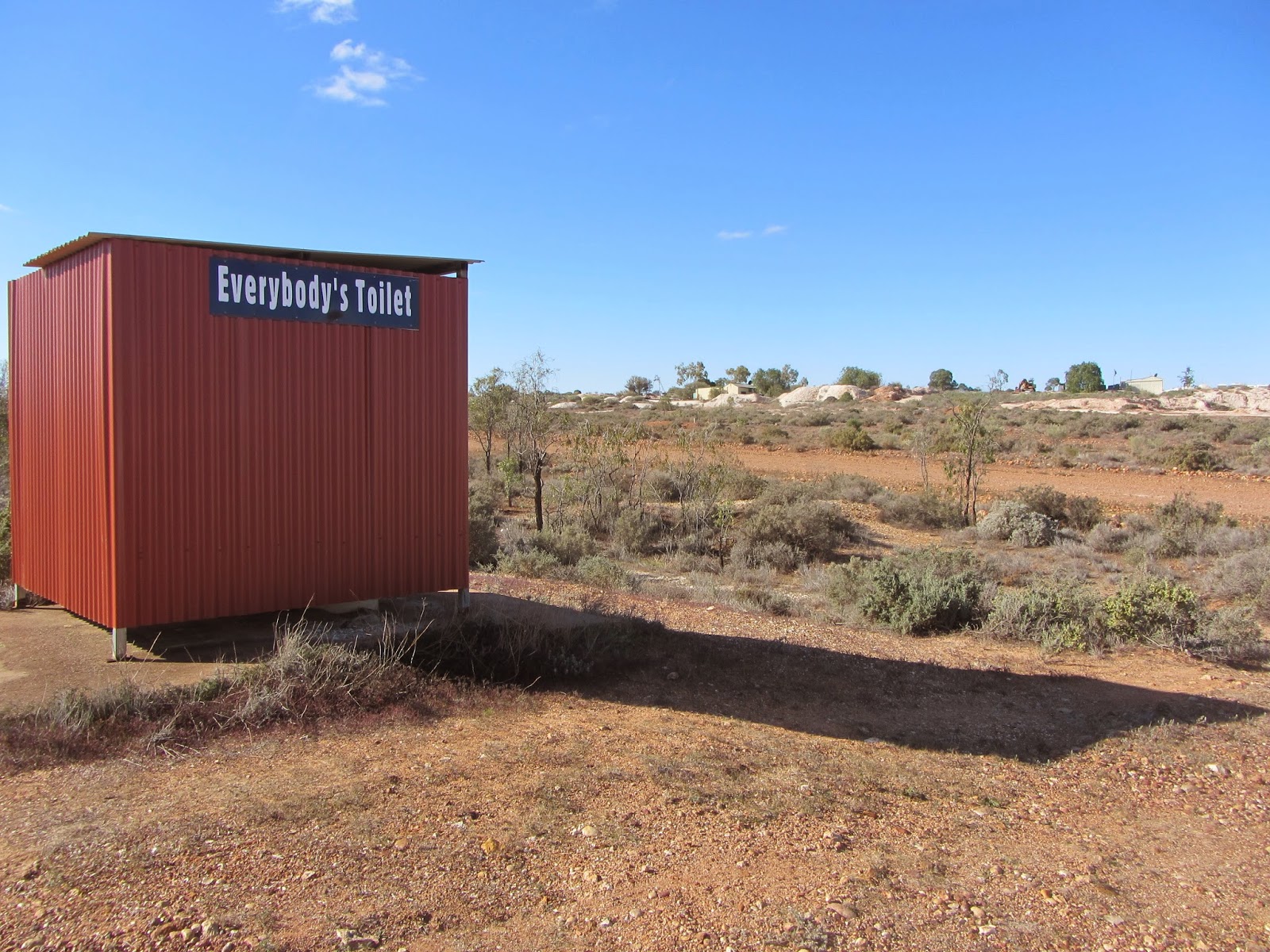
After lunch we drove the Heritage Trail which takes you through the various claims and old shafts of White Cliffs. The heritage areas have names like Everybody's, Busybody's and Nobody's and on each of the areas was a toilet with the same name!
We stopped off at he Southern Cross Opal Gallery to have a look. It's funny, when you think of a Gallery, you picture a pretty classy looking building but that's not the case here in White Cliffs. It is dug into the hill and it is called a dugout. There were 6-8 wrecks of cars around the entrance. Cars are just left where they drop. In the window of the General Store are ads for Dugouts For Sale.
We like White Cliffs. It is an interesting place and if you were here long enough to meet the locals, they would be fascinating too. When we did the tour yesterday, Graham said he works in the café during the day, does the mine tour at 3pm for a couple of hours and then goes down the mine. The fellow at the Southern Cross Gallery today said he goes down the mine for a few hours before opening the Gallery at 9am.
Friday, 11 July 2014
Thursday, 10 July 2014
Wilcannia to White Cliffs - 10 July 2014
The road from Wilcannia to White Cliffs was sealed all the way but with lots of road kill. There are lots of signs along the road advising that black cattle are free grazing. They are very hard to see. We have heard of them being hit but haven't seen any of the black ones as road kill, only a Hereford on the road beside the Darling. It is only 90 odd kms from Wilcannia to White Cliffs so didn't take long.
Our first stop was the Red Earth Opal Café for morning tea.
There was some beautiful opal jewellery for sale and some interesting opals on display. There was even a piece of opalised wood. The pineapple opal cluster (I think that is the term) is a feature of the White Cliffs Opal area and looks like a starburst.
He had a few of these and they can be worth a bit of money. The fellow who owns the café is the only professional opal miner in White Cliffs. He runs a tour each afternoon so we booked on his tour.
Graham (I think that is his name) has had the mine for 22 years, and before that he used to come up twice a year as a kid with his family. He has a few mines. Each claim measures 50m x 50m and you can have 2 in each name, but since the 1990's if you have a claim (in NSW at least), you must have done a mine course. The days of putting the claims in your pet's names have gone. Each claim costs $100 to register. Graham has made his annual income since March, but I imagine that doesn't always happen, and doesn't happen to everyone. He lives here all year and his wife and kids come up a few times a year - I imagine school holidays. They live on the Central Coast at Umina and left this morning to go home. School holidays finish this week.
He took us on a tour of his mines and it was very interesting. He can fill a dump truck in 2 hours by means of a large bucket machine he built which goes down a shaft, is filled and comes up into the truck. I had a dig for opal but I don't think I would enjoy it as a career.
Opal was discovered in Ethiopia a few years ago and the Australian opal market, which is the largest in the world, suffered as it was selling more cheaply. However, it has since been found that it is a lower grade opal. It absorbs water and over time this strips the colour. The Australian opal market is bouncing back as a result of these findings.
There have been no mining fatalities in White Cliffs since it was first discovered. There is also very little crime in the place.
We are staying at the caravan park in White Cliffs. It is only small but got everything we need, mainly power for the very cold nights. However there are signs advising that the water is not fit for human consumption. Luckily, we have our own water.
Our first stop was the Red Earth Opal Café for morning tea.
There was some beautiful opal jewellery for sale and some interesting opals on display. There was even a piece of opalised wood. The pineapple opal cluster (I think that is the term) is a feature of the White Cliffs Opal area and looks like a starburst.
He had a few of these and they can be worth a bit of money. The fellow who owns the café is the only professional opal miner in White Cliffs. He runs a tour each afternoon so we booked on his tour.
He took us on a tour of his mines and it was very interesting. He can fill a dump truck in 2 hours by means of a large bucket machine he built which goes down a shaft, is filled and comes up into the truck. I had a dig for opal but I don't think I would enjoy it as a career.
Opal was discovered in Ethiopia a few years ago and the Australian opal market, which is the largest in the world, suffered as it was selling more cheaply. However, it has since been found that it is a lower grade opal. It absorbs water and over time this strips the colour. The Australian opal market is bouncing back as a result of these findings.
There have been no mining fatalities in White Cliffs since it was first discovered. There is also very little crime in the place.
We are staying at the caravan park in White Cliffs. It is only small but got everything we need, mainly power for the very cold nights. However there are signs advising that the water is not fit for human consumption. Luckily, we have our own water.
Wednesday, 9 July 2014
Wilcannia - 9 July 2014
We had a little rain overnight. It didn't last long and sounded like tiny stones were being thrown at the caravan park. The winds were quite strong overnight but today as the day went on the ferocity of them increased. According to the forecast they were supposed to increase to 65 kpm. I wouldn't be surprised if they were stronger than that. We even packed our back awning away and pulled the roof of our pop-top down. There is a van across from us, belonging to one of the builders working in town at the school, and it just about lost his awning. Bruce and another fellow went over to try and fix it, but it didn't last long. We saw other people working on it again after that. He has a great heater made from a 44 gallon drum.
We spoke to a couple this morning who had driven in from Cobar this morning in their van, into the wind. They could see their fuel gauge dropping very quickly.
We had some morning tea in town before filling up with fuel. The price at the BP Depot wasn't too bad - $1.67.9. There was an enclosure just behind the diesel pump with 3 snarling dogs. I think that is an indication of the security measures needed!
Wilcannia, settled in the 1860's, was a large inland river port in its heyday. Unfortunately, those days are long gone. But there are some beautiful sandstone buildings left from that era and we drove round and had a look at them. The Police Station and residence and the Courthouse are lovely. The building called The Athenaeum (School of Arts with library and reading rooms) was built in 1884. The youngest son of Charles Dickens, Edward Dickens, was on the committee. Wilcannia Cricket Club had 2 of Charles Dickens on the committee at one time. What is now the Wilcannia Golf Club was the first brewery in Australia in 1890 of Edmund Resch, a famous beer baron. The Hospital was also a lovely building.
As we left the supermarket, a truck went past with a huge boat on it. It was on the road to White Cliffs and Broken Hills. Not much water out that way!
As we were leaving town and heading back to the Caravan Park, we stopped off to have a look at the old bridge which is now Heritage Listed. It was built in 1896. When it was first built there were a lot of sheep with drovers on the road. In the early 1900's an old woman lived near the bridge and had a pet sheep that she would hire out at 10 pound a time to lead the drover's mobs across the bridge. 10 pounds in those days would have been worth a fortune.
We spent the afternoon inside the van as it was just so windy. Late this afternoon we went over to reception as a talk was being given by an indigenous artist, Eddy Harris. He talked about his paintings and how he started as an artist. He used to work in the mines at Broken Hill. The mine closed down and he thought he would give painting a go. He started off painting sandshoes and selling them to his friends. Last year he won the Pro Hart Prize for Hanging Art at Dunedoo I think it was. About 400 artists enter. He was very interesting to list to. He had a couple of didgeridoos he had painted and played one of them. He then turned it around and played it from the other end. It sounded completely different. He showed us some beautiful painted emu eggs.
We had a bit more rain tonight as we were preparing dinner. Again, not much to speak of. The wind was still blowing. We heard on the news about the 140 kph winds that were hitting Victoria. Hope they stay there.
We spoke to a couple this morning who had driven in from Cobar this morning in their van, into the wind. They could see their fuel gauge dropping very quickly.
We had some morning tea in town before filling up with fuel. The price at the BP Depot wasn't too bad - $1.67.9. There was an enclosure just behind the diesel pump with 3 snarling dogs. I think that is an indication of the security measures needed!
Wilcannia, settled in the 1860's, was a large inland river port in its heyday. Unfortunately, those days are long gone. But there are some beautiful sandstone buildings left from that era and we drove round and had a look at them. The Police Station and residence and the Courthouse are lovely. The building called The Athenaeum (School of Arts with library and reading rooms) was built in 1884. The youngest son of Charles Dickens, Edward Dickens, was on the committee. Wilcannia Cricket Club had 2 of Charles Dickens on the committee at one time. What is now the Wilcannia Golf Club was the first brewery in Australia in 1890 of Edmund Resch, a famous beer baron. The Hospital was also a lovely building.
As we left the supermarket, a truck went past with a huge boat on it. It was on the road to White Cliffs and Broken Hills. Not much water out that way!
As we were leaving town and heading back to the Caravan Park, we stopped off to have a look at the old bridge which is now Heritage Listed. It was built in 1896. When it was first built there were a lot of sheep with drovers on the road. In the early 1900's an old woman lived near the bridge and had a pet sheep that she would hire out at 10 pound a time to lead the drover's mobs across the bridge. 10 pounds in those days would have been worth a fortune.
We spent the afternoon inside the van as it was just so windy. Late this afternoon we went over to reception as a talk was being given by an indigenous artist, Eddy Harris. He talked about his paintings and how he started as an artist. He used to work in the mines at Broken Hill. The mine closed down and he thought he would give painting a go. He started off painting sandshoes and selling them to his friends. Last year he won the Pro Hart Prize for Hanging Art at Dunedoo I think it was. About 400 artists enter. He was very interesting to list to. He had a couple of didgeridoos he had painted and played one of them. He then turned it around and played it from the other end. It sounded completely different. He showed us some beautiful painted emu eggs.
We had a bit more rain tonight as we were preparing dinner. Again, not much to speak of. The wind was still blowing. We heard on the news about the 140 kph winds that were hitting Victoria. Hope they stay there.
Tuesday, 8 July 2014
Trilby Station to Wilcannia - 8 July 2014
We have had a great time at Trilby Station and it put on a farewell show for us. As we were packing up, a couple of the guys mustered a few hundred sheep up the road and into one of the holding yards. The fellows were on bikes and using one of the dogs, who actually invited himself as soon as he saw what was happening. It was good to see.
The road from Bourke to Wilcannia beside the Darling River (the Darling Run as it is called), although dirt, was not too bad. We drove along the eastern side to Louth then crossed the river to the western side. You can do either side. The section from Bourke to Trilby Station was the better half. The section from Trilby to Wilcannia was good in parts, but in others was a bit rough. But we were happy to take our time and poke along doing about 60 kph. We came across roadworks just before Tilpa where they were grading the road and widening it a bit.
We stopped at Tilpa for lunch at the Royal Mail Hotel, built in 1894. An interesting hotel as, over the years, people have signed their names and written messages on the walls, ceiling fans, old petrol bowser in one of the rooms. In fact anywhere there is a space.
It only costs $2 to do this and all the money goes to the Royal Flying Doctors.
Tilpa has the shortest Heritage Walk. On one side of the road is the Royal Mail Hotel and on the side of the road is a War Memorial. On the War Memorial is Breaker Morant's name from the Boer War, a resident of the area at the time. Tilpa also has a cemetery with no one buried in it!
Diesel is $2 a litre here.
We arrived at Warrawong on the Darling Caravan Park at Wilcannia. It is a new Caravan Park about 3 kms out of Wilcannia and is on a billabong of the Darling River. The amenities block is fabulous with really big showers that also includes a basin and a mirror. We sat around the campfire last night talking to some of the travellers and picked up some tips on White Cliffs which is where we will be heading next.
There are a couple of baby goats roaming around the Caravan Park. They came up and made themselves welcome around the campfire.
We have heard mixed reports about Wilcannia and the problems in the town with the Aboriginals. The latest we have heard is that the town is turning around. Bruce spoke to a fellow staying at the caravan park while doing some building work in the town and he said it has been good. There have been no problems at all. We will have a walk around town tomorrow.
The road from Bourke to Wilcannia beside the Darling River (the Darling Run as it is called), although dirt, was not too bad. We drove along the eastern side to Louth then crossed the river to the western side. You can do either side. The section from Bourke to Trilby Station was the better half. The section from Trilby to Wilcannia was good in parts, but in others was a bit rough. But we were happy to take our time and poke along doing about 60 kph. We came across roadworks just before Tilpa where they were grading the road and widening it a bit.
We stopped at Tilpa for lunch at the Royal Mail Hotel, built in 1894. An interesting hotel as, over the years, people have signed their names and written messages on the walls, ceiling fans, old petrol bowser in one of the rooms. In fact anywhere there is a space.
It only costs $2 to do this and all the money goes to the Royal Flying Doctors.
Tilpa has the shortest Heritage Walk. On one side of the road is the Royal Mail Hotel and on the side of the road is a War Memorial. On the War Memorial is Breaker Morant's name from the Boer War, a resident of the area at the time. Tilpa also has a cemetery with no one buried in it!
Diesel is $2 a litre here.
We arrived at Warrawong on the Darling Caravan Park at Wilcannia. It is a new Caravan Park about 3 kms out of Wilcannia and is on a billabong of the Darling River. The amenities block is fabulous with really big showers that also includes a basin and a mirror. We sat around the campfire last night talking to some of the travellers and picked up some tips on White Cliffs which is where we will be heading next.
There are a couple of baby goats roaming around the Caravan Park. They came up and made themselves welcome around the campfire.
We have heard mixed reports about Wilcannia and the problems in the town with the Aboriginals. The latest we have heard is that the town is turning around. Bruce spoke to a fellow staying at the caravan park while doing some building work in the town and he said it has been good. There have been no problems at all. We will have a walk around town tomorrow.
Monday, 7 July 2014
Trilby Station - 7 July 2014
It was a beautiful day today. Cool this morning - below zero - but the sun was shining and there was no wind.
We went for a drive this morning, the second mud map drive of the property. This one is to the old Dunlop Farm Buildings and will only be about 25 kms and most of that is on the main road. The drive we did the other day was about 75 kms and most of it was over the Station itself.
Trilby Station was once a part of Dunlop Station, the first station in the world to complete a mechanical shearing. The actual Dunlop Homestead from the original property is not owned by Liz and Gary so we couldn't have a look at it unfortunately. The Dunlop Farm buildings that we did go to see was the location of the farm buildings and home to those employed there. It was built on the Darling River. The road leading to it off the main road was a very rough road, but the remains there were worth looking at. Pieces of history.
There were various bits of old machinery - steam traction engine, a threshing machine/chaff cutter, an early model horse drawn harvester built by Hugh McKay, who invented the combine harvester. The one that intrigued me was the jinker with solid wooden wheels.
The jinker was a flat wagon type arrangement used to haul cut wood to the steam boilers and steam engines.
A little bit further along, on the edge of the riverbank, was a huge boiler, which was above a timber slipway that was used to drag equipment from paddle steamers straight up the very steep banks, and vice versa. The ingenuity of the farmers in days gone by was quite amazing. The quality of the steel and the workmanship was outstanding as the boiler is still standing. It is very rusted and bits missing, but it is still standing straight and tall.
There were the stumps of one of the buildings and not far from that, were the remains of a baker's oven, built from homemade bricks.
We arrived back at the van in time for morning tea and then read/sewed for the rest of the morning. While we were sitting there, we were treated to a flock of the black cockatoos in a tree nearby. Beautiful birds with their red under the wings and in their tails.
We had run out of bread so Bruce made some pufties (puftaloons) or fried scones for lunch. His Mum used to make them when Bruce was little and so he used to cook them for the boys and I when we went away on holidays and did some bushwalking. We haven't had them for quite a few years but he hasn't lost his touch.
Di and Dave are a couple from Victoria. They came to Trilby Station 7 years ago as paying visitors but have been back every year since and work while they are here. They usually cover for Liz when she goes overseas. A nice couple. We chatted to them this afternoon for a while as we are thinking of going home via Tibooburra and Cameron's Corner. Just need to check on the roads before we make our final decision. They were also telling us about the number of people who pinch toilet paper, which we have heard also from caravan park people. Another thing Di was saying that people pinch are bottles of gas. Near us is the camp kitchen and they used to keep a 9kg bottle of gas hooked up there. People were taking that and putting their empty one in its place! What a hide some people have.
We went for an extra long walk today and followed the dry billabong. There are campsites around that as well but as the billabong is dry, they are closed at the moment. In the centre of the billabong, you could tell there was moisture/water below the surface as we had to be careful we didn't sink. It was dry and cracked on top. The kangaroos were out in droves, possibly as it was such a lovely day.
Bruce is certainly hogging the camera!
We went for a drive this morning, the second mud map drive of the property. This one is to the old Dunlop Farm Buildings and will only be about 25 kms and most of that is on the main road. The drive we did the other day was about 75 kms and most of it was over the Station itself.
Trilby Station was once a part of Dunlop Station, the first station in the world to complete a mechanical shearing. The actual Dunlop Homestead from the original property is not owned by Liz and Gary so we couldn't have a look at it unfortunately. The Dunlop Farm buildings that we did go to see was the location of the farm buildings and home to those employed there. It was built on the Darling River. The road leading to it off the main road was a very rough road, but the remains there were worth looking at. Pieces of history.
There were various bits of old machinery - steam traction engine, a threshing machine/chaff cutter, an early model horse drawn harvester built by Hugh McKay, who invented the combine harvester. The one that intrigued me was the jinker with solid wooden wheels.
The jinker was a flat wagon type arrangement used to haul cut wood to the steam boilers and steam engines.
A little bit further along, on the edge of the riverbank, was a huge boiler, which was above a timber slipway that was used to drag equipment from paddle steamers straight up the very steep banks, and vice versa. The ingenuity of the farmers in days gone by was quite amazing. The quality of the steel and the workmanship was outstanding as the boiler is still standing. It is very rusted and bits missing, but it is still standing straight and tall.
There were the stumps of one of the buildings and not far from that, were the remains of a baker's oven, built from homemade bricks.
We arrived back at the van in time for morning tea and then read/sewed for the rest of the morning. While we were sitting there, we were treated to a flock of the black cockatoos in a tree nearby. Beautiful birds with their red under the wings and in their tails.
We had run out of bread so Bruce made some pufties (puftaloons) or fried scones for lunch. His Mum used to make them when Bruce was little and so he used to cook them for the boys and I when we went away on holidays and did some bushwalking. We haven't had them for quite a few years but he hasn't lost his touch.
Di and Dave are a couple from Victoria. They came to Trilby Station 7 years ago as paying visitors but have been back every year since and work while they are here. They usually cover for Liz when she goes overseas. A nice couple. We chatted to them this afternoon for a while as we are thinking of going home via Tibooburra and Cameron's Corner. Just need to check on the roads before we make our final decision. They were also telling us about the number of people who pinch toilet paper, which we have heard also from caravan park people. Another thing Di was saying that people pinch are bottles of gas. Near us is the camp kitchen and they used to keep a 9kg bottle of gas hooked up there. People were taking that and putting their empty one in its place! What a hide some people have.
We went for an extra long walk today and followed the dry billabong. There are campsites around that as well but as the billabong is dry, they are closed at the moment. In the centre of the billabong, you could tell there was moisture/water below the surface as we had to be careful we didn't sink. It was dry and cracked on top. The kangaroos were out in droves, possibly as it was such a lovely day.
Bruce is certainly hogging the camera!
Sunday, 6 July 2014
Trilby Station - 6 July 2014
We slept in this morning till 8 o'clock - unheard of normally for us.
We heard there was a big group coming in today. A father and son group of about 17. They are booked into the shearers quarters. We decided to do some washing and tried out the container and plunger we bought for this purpose. It worked pretty well.
The 3 families from Brisbane that were camped near us left this morning for White Cliffs. They are working their way home. I think the school holidays finish next weekend.
We had a look inside the new Shearing Shed near our campsite this morning. It is huge and has a raised timber floor. It looks like you could hold a dance inside and in fact, the Murray's daughter, Alex, had her 30th birthday inside late last year. It is certainly state of the art.
We headed into Louth for lunch at Shindy's Inn. Louth was established by Thomas Mathews and named after County Louth in Ireland where he came from. He left his wife of 6 years, Mary, in Ireland until he had established himself here, before bringing her out. She died when she was 42. He commissioned a granite monument to be built in Bendigo, by which time Thomas was married for the 3rd time. I wonder how his 3rd wife felt. The monument took nearly 3 years to come by paddle steamer as the Darling River was at an all time low at the time. The monument, a Celtic Cross, is 7 metres tall. Every year on the anniversary of Mary's death in August, the sun reflects from the Celtic Cross to the front door of the spot where their house once stood.
Louth has only the pub, Shindy's Inn. It is supposed to have a General Store but I think that has since closed, as we saw no sign of it. There is a small primary school, an oval (made of dirt and stones), a tennis club with a couple of courts and outside town there is a huge race track. They have a big race meet in August each year. In days gone by, the town had 3 hotels, a cordial factory, 3 bakeries, 2 butchers, a post office, 3 churches, a Chinese garden, a general store and a police station. It now has a population of 35.
It didn't warm up at all today. There was a cold wind blowing all day. There was the possibility of rain but the chances weren't high. I spoke to Di, a lady working on the property at the moment, who said that Liz usually lets you know if it is going to rain, to give people the opportunity of getting out. There only needs to be 5ml and you can't get out of the property. That's because of the red dust/dirt.
Also, when I was talking to Di, she said there is a group of 180 people coming in August/September. They have requested a dinner and a breakfast, which Liz does on request for anyone staying. The meal will be set up and served in the big shearing shed.
We heard there was a big group coming in today. A father and son group of about 17. They are booked into the shearers quarters. We decided to do some washing and tried out the container and plunger we bought for this purpose. It worked pretty well.
The 3 families from Brisbane that were camped near us left this morning for White Cliffs. They are working their way home. I think the school holidays finish next weekend.
We had a look inside the new Shearing Shed near our campsite this morning. It is huge and has a raised timber floor. It looks like you could hold a dance inside and in fact, the Murray's daughter, Alex, had her 30th birthday inside late last year. It is certainly state of the art.
We headed into Louth for lunch at Shindy's Inn. Louth was established by Thomas Mathews and named after County Louth in Ireland where he came from. He left his wife of 6 years, Mary, in Ireland until he had established himself here, before bringing her out. She died when she was 42. He commissioned a granite monument to be built in Bendigo, by which time Thomas was married for the 3rd time. I wonder how his 3rd wife felt. The monument took nearly 3 years to come by paddle steamer as the Darling River was at an all time low at the time. The monument, a Celtic Cross, is 7 metres tall. Every year on the anniversary of Mary's death in August, the sun reflects from the Celtic Cross to the front door of the spot where their house once stood.
Louth has only the pub, Shindy's Inn. It is supposed to have a General Store but I think that has since closed, as we saw no sign of it. There is a small primary school, an oval (made of dirt and stones), a tennis club with a couple of courts and outside town there is a huge race track. They have a big race meet in August each year. In days gone by, the town had 3 hotels, a cordial factory, 3 bakeries, 2 butchers, a post office, 3 churches, a Chinese garden, a general store and a police station. It now has a population of 35.
It didn't warm up at all today. There was a cold wind blowing all day. There was the possibility of rain but the chances weren't high. I spoke to Di, a lady working on the property at the moment, who said that Liz usually lets you know if it is going to rain, to give people the opportunity of getting out. There only needs to be 5ml and you can't get out of the property. That's because of the red dust/dirt.
Also, when I was talking to Di, she said there is a group of 180 people coming in August/September. They have requested a dinner and a breakfast, which Liz does on request for anyone staying. The meal will be set up and served in the big shearing shed.
Saturday, 5 July 2014
Trilby Station - 5 July 2014
We have a very cool wind blowing again for the last couple of days. Last night wasn't as cold as it has been and the temperatures look like they will be a couple of degrees higher in the early mornings for the next few days.
We went to see Liz this morning to pick up a mud map from her for a drive round the property. She said that her, Gary and their son, Will, would be flying to Enngonia, up on the Queensland border, as they had a Race Day on today. She was trying to work out what to wear - hat, shoes, etc.
The have a hangar not from the house, which has 3 planes parked in and outside it. The main plane that is used they bought nearly 30 years ago secondhand from Redcliffe in Brisbane. Liz calls it Gary's Toyota in the sky. In summer the water in each paddock must be checked almost daily. By road this is over 400km and takes around 11 hours. By air, it takes about an hour and a half.
Their property continues on the other side of the road from Louth to Wilcannia and this is where we started the drive. It is all flood plain at the beginning and so very flat and this section is also naturally treeless.
We came across where the stockmen used to live, which has been destroyed by white ants. You could still see the timber tank stand, the stirrups for the house and the cement steps, as well as a brick fire place. The outdoor toilet or dunny was still standing as well. There were axles of cars strewn through the ground, springs from seats and an old kerosene fridge.
Feral goats are a very important source of income for the property. A female goat begins breeding at about 7 months, breeds twice a year and often has 2, 3 or 4 kids at a time. They graze on scrub rather than grasses so are great for the scrubby areas. The goats are only considered yours to muster when they are on your property. Sale price varies from around $14 per head up to $50 depending on supply/demand at the time. We have seen quite a few goats on our travels out this far west. Liz says that no grazier would still be viable here without the income from the feral goats over the years.
Newchum is where there is another hangar which they work from in times of flood. There is an old Sydney double decker bus parked next to the hangar. The two guys who did most of the fencing of the original property in the '50's and '60's, Maurie Hocking and Allan Jordan, lived in the old bus when they were working on the property. They used to drive it into Louth, occasionally, on a Sunday afternoon and take the kids there for a joy-ride. They also liked a drink and miscalculated the height of a bridge one day and hit the top of the bus.
Not far from the Newchum hangar is an old homestead, one of 3 or 4 on the property. It was built in the 1950's for Gary's parents. They moved from there in 1965 and as their new house was fully furnished, they left everything in the Newchum homestead, including food. We walked through the house. There was an old boiler for the washing and a wringer machine. There was also an old Aga range, which was usually left on all day with a kettle on top. There was a kerosene fridge, as well as boxes of starch powder and Zest plant food. They had a couple of papers left on the table from the 1970's. The house was used if anyone working in the area needed overnight accommodation.
It was a great drive and very interesting looking around the old buildings.
We took our morning tea and lunch with us, which was good, as we ended up being gone for about 4 hours. We arrived back at the van for afternoon tea before heading out for a long walk again. As we were coming past the airstrip, Gary was landing the plane. They were back from their day at the Races.
We went to see Liz this morning to pick up a mud map from her for a drive round the property. She said that her, Gary and their son, Will, would be flying to Enngonia, up on the Queensland border, as they had a Race Day on today. She was trying to work out what to wear - hat, shoes, etc.
The have a hangar not from the house, which has 3 planes parked in and outside it. The main plane that is used they bought nearly 30 years ago secondhand from Redcliffe in Brisbane. Liz calls it Gary's Toyota in the sky. In summer the water in each paddock must be checked almost daily. By road this is over 400km and takes around 11 hours. By air, it takes about an hour and a half.
Their property continues on the other side of the road from Louth to Wilcannia and this is where we started the drive. It is all flood plain at the beginning and so very flat and this section is also naturally treeless.
We came across where the stockmen used to live, which has been destroyed by white ants. You could still see the timber tank stand, the stirrups for the house and the cement steps, as well as a brick fire place. The outdoor toilet or dunny was still standing as well. There were axles of cars strewn through the ground, springs from seats and an old kerosene fridge.
From there, we headed further across the property. We went through their goat paddocks. Goats were introduced into Australia with the First Fleet and introduced into inland Australia with settlers, miners and railway workers. They roamed free and reverted to the wild. Cashmere and Angora goats were introduced in 1861 but the venture failed due to the competition with wool. Feral goats are a very important source of income for the property. A female goat begins breeding at about 7 months, breeds twice a year and often has 2, 3 or 4 kids at a time. They graze on scrub rather than grasses so are great for the scrubby areas. The goats are only considered yours to muster when they are on your property. Sale price varies from around $14 per head up to $50 depending on supply/demand at the time. We have seen quite a few goats on our travels out this far west. Liz says that no grazier would still be viable here without the income from the feral goats over the years.
Newchum is where there is another hangar which they work from in times of flood. There is an old Sydney double decker bus parked next to the hangar. The two guys who did most of the fencing of the original property in the '50's and '60's, Maurie Hocking and Allan Jordan, lived in the old bus when they were working on the property. They used to drive it into Louth, occasionally, on a Sunday afternoon and take the kids there for a joy-ride. They also liked a drink and miscalculated the height of a bridge one day and hit the top of the bus.
Not far from the Newchum hangar is an old homestead, one of 3 or 4 on the property. It was built in the 1950's for Gary's parents. They moved from there in 1965 and as their new house was fully furnished, they left everything in the Newchum homestead, including food. We walked through the house. There was an old boiler for the washing and a wringer machine. There was also an old Aga range, which was usually left on all day with a kettle on top. There was a kerosene fridge, as well as boxes of starch powder and Zest plant food. They had a couple of papers left on the table from the 1970's. The house was used if anyone working in the area needed overnight accommodation.
It was a great drive and very interesting looking around the old buildings.
We took our morning tea and lunch with us, which was good, as we ended up being gone for about 4 hours. We arrived back at the van for afternoon tea before heading out for a long walk again. As we were coming past the airstrip, Gary was landing the plane. They were back from their day at the Races.
Subscribe to:
Posts (Atom)
