Our car was due for its 40,000 km service so we had booked it in here at Broken Hill for today. We dropped it off early and had breakfast at Charlotte's where we had morning tea the other day. It was very nice. While we were having breakfast, we heard the shocking news about the Malaysian Airlines plane shot down in the Ukraine. It makes you want to cry for all those poor people and their families.
After that we headed down to the Information Centre to meet our guide, Jean, who was doing the walking tour of Broken Hill. The walking tours started in their Centenary year (1888) but the guides are getting older now and unless they can recruit some more people, they will have to either scale them back or cut them out. That would be a real shame.
While we were on our tour, I checked the temperature as it was a bitterly cold wind blowing. At 10.30 this morning it was 8.6 degrees but with the wind chill factor it was 4.9 degrees. Very cold.
Jean took us to some of the places we had already been to, but also some new ones. She took us inside the Trades Hall. Unions played a huge part in Broken Hill's history and development. There were 3 big strikes in the mines in Broken Hill - 1892, 1909 and 1919. Each strike lasted for a few months. In the Trades Hall, there were historical photos of these strikes and also other events. There were also banners carried by the Unions in the big parades.
Also in the building is a function room which was used for weddings, dances, etc. The whole building has been renovated.
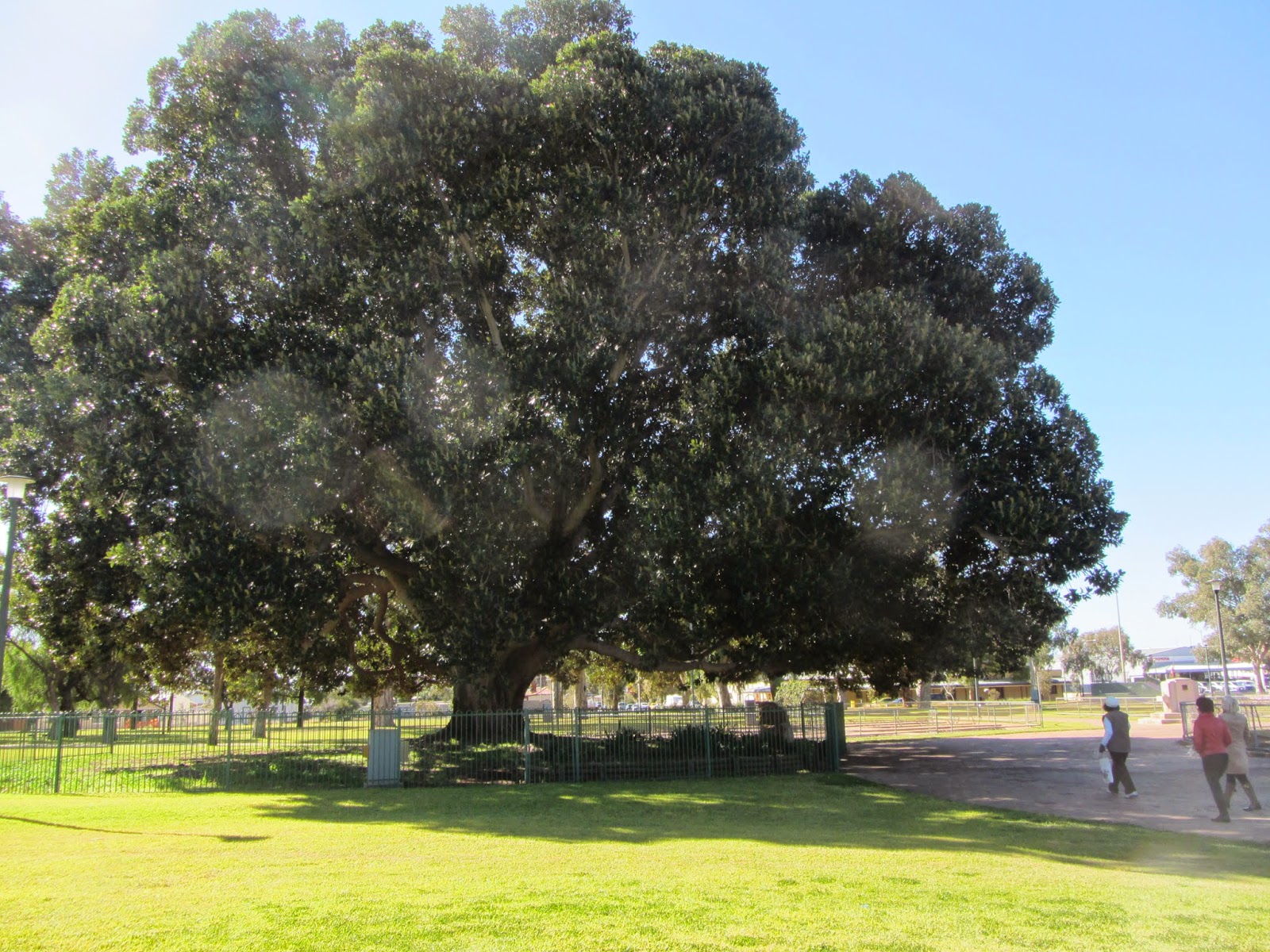
After the Trades Hall, we went to Sturt Park. It is a lovely park and is where Carols by Candlelight are held each year. There is a huge Moreton Bag fig tree, more than 100 years old that has all fairy lights through it which are lit at Christmas. It must look beautiful.
Also under the tree is a memorial to the Afghan cameleers, who played a big part in Broken Hill's early days. They did the deliveries of goods out to the outlying Stations.
There is also a memorial in the park to the band members of the Titanic as well as a rose garden planted in memory of those killed in Port Arthur. The townspeople really want to be involved in what is happening in Australia and elsewhere. There are lots of memorials round town.
Charles Rasp is the person who found the initial minerals in the ground here in Broken Hill. He was a boundary rider on Mt Gipps Station, a nearby property which encompassed Broken Hill. He thought it was tin and sent it away to be tested. When the news came back that it was a really rich deposit of silver, lead and zinc, the Syndicate of Seven was formed from workers on the property to become BHP. Most of them went on to become very wealthy but a couple of them sold their shares very cheaply. BHP eventually left Broken Hill in the 1930's.
After the tour finished, we went to have a look through the Geocentre, which is a minerals and mining museum. The main reason I wanted to go and look is they have a tree made of 7.5kg of silver made in 1880. It was lovely. There was also a silver nugget weighing 42kg.
I took the photo of the Silver Tree and then noticed a sign which said no photos.
We then walked down to the Palace Hotel, a really old hotel used in the film Priscilla, Queen of the Desert. We were able to have a look downstairs but not allowed upstairs. There are so many murals throughout, some of them better than others.
Our car was ready by this time, so we picked it up and went to have a look at the Bush 'n Beyond Gallery displaying art by Wendy Martin and Ian Lewis. There were some nice paintings there, and Wendy also does jewellery.
We came back to the caravan and I left Bruce there. The wind is playing havoc with his sinuses and he is not 100%. I walked down the road to the cemetery. I love walking through cemeteries. There is a walking trail through Broken Hill's cemetery with a brochure pointing out graves of interest. Ion Idriess' mother, Julia, is buried here. She died during a typhoid epidemic. Pro Hart is also buried here. What was sad was the number of children who have died at such a young age. The cemetery is the second largest in Australia, with 60,000 people buried here. The largest is at Brookvale, although that one is 2 cemeteries joined together.
Friday, 18 July 2014
Thursday, 17 July 2014
Broken Hill - 17 July 2014
I read another article about the shooting during World War I involving the
ice cream van today. There was a trainload of people going to a picnic at
Silverton, just out of Broken Hill. 3 people died and another 6 were wounded,
some badly. Both of the shooters were killed by police. Not so funny now.
I read another interesting story today. During World War II, there were fears that Japan would invade Australia. The Commonwealth Bank held most of Australia’s gold in its strongrooms. It was decided that the safest place to store the gold was Broken Hill gaol. The first transfer took place in 1942 by train and the guards knew what the cargo was. More transfers took place. Then it had to be returned and again no one was the wiser.
We were picked up at the caravan park by the mini bus for the tour of the Miner’s Memorial. Peter, our tour guide, drove us through a couple of the areas near town and gave us some information on the place.
There are currently 19,000 people in Broken Hill. At its peak, there were 34,000 but one of the mines closed in the 1970’s and another one in 1993. There is only about 15 years of mining in the current mines, provided the price remains viable. If it gets down below $1,300 a tonne, it is no longer viable to mine. There are 600 people employed directly in the Mines, but then you have the support companies.
There were 72 hotels in town at the peak of the mining boom but this has now dropped to 19, plus 4 clubs.
There are currently 2 mines operating in Broken Hill. One is owned by the Chinese and the ore goes to Port Pirie in South Australia for processing. The other mine is owned by the Japanese and the ore from this one goes to Newcastle. Both mines were on the point of closing and no one in Australia was interested in buying them so they went to the current owners.
After leaving the CBD we drove to the Junction Mine and Browne’s Shaft. This mine closed in 1972, but was first pegged in 1882. The mine equipment has been left intact. Peter used to work in the mines for about 25 years. I wouldn’t have liked to travel down in the cart that takes you underground. Apparently 5 men fitted in each one. It would have been a tight squeeze.
We had afternoon tea at The Silly Goat, which was lovely. Bruce had
Carrot Cake and I had Zucchini and Pineapple Loaf.
We then went to Jack Absalom’s Gallery to have a look. He has the
largest collection of opals in the Southern Hemisphere, as well as his
paintings. I liked his paintings, loved the colours. We didn’t buy any though.
Could have bought a print but there are no spare walls left in our house. They
have quilts on them!
We did go to a patchwork shop today as well and
I bought a couple of fabrics that I am after for my next quilt. I left a happy
girl!
I read another interesting story today. During World War II, there were fears that Japan would invade Australia. The Commonwealth Bank held most of Australia’s gold in its strongrooms. It was decided that the safest place to store the gold was Broken Hill gaol. The first transfer took place in 1942 by train and the guards knew what the cargo was. More transfers took place. Then it had to be returned and again no one was the wiser.
We were picked up at the caravan park by the mini bus for the tour of the Miner’s Memorial. Peter, our tour guide, drove us through a couple of the areas near town and gave us some information on the place.
There are currently 19,000 people in Broken Hill. At its peak, there were 34,000 but one of the mines closed in the 1970’s and another one in 1993. There is only about 15 years of mining in the current mines, provided the price remains viable. If it gets down below $1,300 a tonne, it is no longer viable to mine. There are 600 people employed directly in the Mines, but then you have the support companies.
There were 72 hotels in town at the peak of the mining boom but this has now dropped to 19, plus 4 clubs.
There are currently 2 mines operating in Broken Hill. One is owned by the Chinese and the ore goes to Port Pirie in South Australia for processing. The other mine is owned by the Japanese and the ore from this one goes to Newcastle. Both mines were on the point of closing and no one in Australia was interested in buying them so they went to the current owners.
After leaving the CBD we drove to the Junction Mine and Browne’s Shaft. This mine closed in 1972, but was first pegged in 1882. The mine equipment has been left intact. Peter used to work in the mines for about 25 years. I wouldn’t have liked to travel down in the cart that takes you underground. Apparently 5 men fitted in each one. It would have been a tight squeeze.
The Miner’s Memorial is very striking. It has been constructed to resemble
the inside of a mine complete with rusty walls. Down one side are the names of
those who have been killed in the mines over the years with any details they
have. The early deaths they only have their name but not how they died, and
most of them were due to Lead Poisoning or Dust on Lungs. The last death was in
2007. Peter showed us his father’s name. His father was killed when Peter was 5
(he would be in his late 60’s now) in a blasting accident.
It was an excellent tour and we are pleased we did it.
After lunch we drove out to the airport and the Royal Flying Doctor
Base, and we did a tour of that. It is the only working RFDS base you can tour.
You start by walking through the interactive display and information boards
outlining the history of the RFDS. It also had a display showing a woman on a
property ringing the RFDS and going through what happened. This was followed by
a film on the RFDS and the scope of its activities and some of the flights it
has undertaken.
The territory covered by the Broken Hill base is astounding. It
includes far west NSW, south-westQueensland, and eastern and northern South
Australia – an area of 640,000 square kilometres.
The room had displays of the huge medicine chests with all bottles numbered
and a corresponding chart that each property has. So if someone gets treatment by radio, they are told
to take so many pills from a certain numbered bottle. They had a poster telling
about a guy who had been told to take 2 pills from No. 9 bottle. When he spoke
to the doctor the next morning, he told the doctor he hadn’t had any left of
that one so had taken one from No. 7 bottle and 1 from No. 2 bottle and he
feels pretty good now!
We were then shown through the communications area and out to the
hangar where there were 2 planes being serviced. Each plane is decommissioned
after 20 years or a certain number of flying hours. They pay for new aircraft
with fundraising. The planes they have now are pressurised so they can fly
above the clouds for a smoother ride for patients.
John Flynn was an amazing man. On a trip to Cloncurry about 10 years
ago, we had looked through John Flynn Place, which is dedicated to him, and he
worked tirelessly to get the RFDS up and running.
Wednesday, 16 July 2014
Broken Hill - 16 July 2014
We had a bit of rain last night. Enough that the ground was still wet
this morning. But we woke to a fog, then a fine day, but a cold wind.
We decided to head up to the Mine of Lode Miner’s Memorial on top of the hill overlooking Broken Hill. There is also a cafe (Broken Earth Cafe) on the hill and we thought it would be a nice place for morning tea. We headed up the road towards it and came across a closed gate across the road and a sign saying that there was no access. We called in to the Information Centre and asked them what the story was. Apparently the cafe had closed in February and as there are no workers on the hill any more, they couldn’t have people wandering round by themselves due to public liability. They are in the process of transferring the land for the Memorial back to Crown Land so people can return. The only way you can go up and see it is on a tour, so we have booked that for tomorrow morning.
We had morning tea at another cafe which was lovely, and it had paintings all round the walls that were for sale. As art is so big in Broken Hill, there are paintings and galleries everywhere.
After morning tea we went to the Broken Hill Art Gallery to have a look. There was an exhibition on but the paintings exhibited were not our cup of tea, except for one. On the 1st floor were their permanent paintings and there were some nice ones there. An unusual one we saw was a waratah made out of cane toad skins. It was great. Unfortunately I couldn't take a picture.
I was reading an interesting piece of information in one of the brochures at morning tea. During World War I, about 4 months before Gallipoli, 2 Turks driving an ice cream truck, attacked a train in Broken Hill. It sounds quite funny so many years after the event, but it wouldn’t have been at the time. It almost sounds like a comedy – an ice cream truck attacking a train!
After lunch we drove out to the Living Desert and Sculpture Symposium. It is about 12 kms out of Broken Hill. The Sculpture Symposium was the idea of sculptor, Lawrence Beck, and was opened in May 1993. It comprises sandstone sculptures by Australian and international sculptors arranged around the top of a hill. The sandstone weighed 53 tonnes. A mammoth undertaking just to get them there. The sculptures are quite striking in their situation.
We decided to head up to the Mine of Lode Miner’s Memorial on top of the hill overlooking Broken Hill. There is also a cafe (Broken Earth Cafe) on the hill and we thought it would be a nice place for morning tea. We headed up the road towards it and came across a closed gate across the road and a sign saying that there was no access. We called in to the Information Centre and asked them what the story was. Apparently the cafe had closed in February and as there are no workers on the hill any more, they couldn’t have people wandering round by themselves due to public liability. They are in the process of transferring the land for the Memorial back to Crown Land so people can return. The only way you can go up and see it is on a tour, so we have booked that for tomorrow morning.
We had morning tea at another cafe which was lovely, and it had paintings all round the walls that were for sale. As art is so big in Broken Hill, there are paintings and galleries everywhere.
After morning tea we went to the Broken Hill Art Gallery to have a look. There was an exhibition on but the paintings exhibited were not our cup of tea, except for one. On the 1st floor were their permanent paintings and there were some nice ones there. An unusual one we saw was a waratah made out of cane toad skins. It was great. Unfortunately I couldn't take a picture.
I was reading an interesting piece of information in one of the brochures at morning tea. During World War I, about 4 months before Gallipoli, 2 Turks driving an ice cream truck, attacked a train in Broken Hill. It sounds quite funny so many years after the event, but it wouldn’t have been at the time. It almost sounds like a comedy – an ice cream truck attacking a train!
After lunch we drove out to the Living Desert and Sculpture Symposium. It is about 12 kms out of Broken Hill. The Sculpture Symposium was the idea of sculptor, Lawrence Beck, and was opened in May 1993. It comprises sandstone sculptures by Australian and international sculptors arranged around the top of a hill. The sandstone weighed 53 tonnes. A mammoth undertaking just to get them there. The sculptures are quite striking in their situation.
We then drove over to The Living Desert, a Fauna and Flora
Sanctuary. There is a designated walk
through the Sanctuary which takes you for just over 3 kms. There are labelled
native plants. One of them that is somewhere in the Sanctuary is Old Man
Saltbush. I would have liked to see what that was like but no luck. We saw a
Butter Bush and a Native Apricot, which actually had fruit on it.
Half way round the track was a Portaloo for those who needed one. Loved
the sign.
There were also information boards on topics relevant to the area. One
of them was on Feral Cats. It is estimated that each feral cat kills 1,000
birds a year within its range of a few square hectares. Some of them can reach
13 kg.
The average rainfall in the area of the Living Desert is 250mm and the
evaporation rate is 2 metres per year! Quite unbelievable. That certainly poses
a few problems for the future provision of water for the Broken Hill area.
As to the maintenance of The Living Desert, it looks like funding has
been cut and maintenance is suffering. Hopefully that doesn’t continue.
Tuesday, 15 July 2014
Menindee to Broken Hill - 15 July 2014
It rained last night, or should I say spat, for a short time and did
the same this morning. This morning it was on and off all morning. Another
cool, miserable day but as we are travelling, that’s okay. We are heading north
now.
We saw a Lookout on the road to Broken Hill which looks out over Menindee Lake so we pulled in to have a look. We were a bit closer to the water and you can see the pipeline which takes the water to Broken Hill. The town water supply comes out of the lake. We also followed for a short way the rail line which carries the Indian Pacific train. We heard it go through this morning while we were packing up.
Menindee is only 110 kms from Broken Hill and we had got away early so
we were in Broken Hill by about 9 to 9.30. Broken Hill is on South Australia
time so we had to wind our watches back.
We went straight to the Information Centre and picked up some brochures
before going for a walk through town. It was a bit early to check in to the
caravan park.
Luckily we continued walking so I could walk some of it off. And I didn't have any lunch.
There is a heritage walk around town and there are signs along the street for the old buildings identifying them and their history. There were also signs around town too for local people who had made a significant contribution with their deeds.
We saw a Lookout on the road to Broken Hill which looks out over Menindee Lake so we pulled in to have a look. We were a bit closer to the water and you can see the pipeline which takes the water to Broken Hill. The town water supply comes out of the lake. We also followed for a short way the rail line which carries the Indian Pacific train. We heard it go through this morning while we were packing up.
The emus are so stupid. You drive along and you come across a large
group of them (they are everywhere out west). The group might be split on each
side of the road. One of the group on the left hand side of the road will take
off left and you know the emus on the right hand side of the road are going to
follow – right across the road. No wonder you see so many of them as road kill.
Stupid things they are.
We stopped at Charlotte’s Cafe for morning tea and I had a scone. What
a huge scone!
Luckily we continued walking so I could walk some of it off. And I didn't have any lunch.
There is a heritage walk around town and there are signs along the street for the old buildings identifying them and their history. There were also signs around town too for local people who had made a significant contribution with their deeds.
We did see some Vegemite and Cheese Sausages for sale. Ah, no thanks. I do like Vegemite but on toast.
We had rung yesterday to book into the Broken Hill Tourist Park for 5
nights. We thought we could always extend the booking if we needed to. It was
hard to work out where to stay. There are only 2 caravan parks in town and both
of them had mixed reviews. There aren’t any free camps around the town. People
we had spoken to said there was a problem with stealing in both caravan parks
so we ended up booking a site with an ensuite and that way we could put our
chairs and things inside the ensuite when we go out. There is also rain
forecast.
The prices vary at the Caravan Park, depending on the type of site you have. There is a price for bitumen and wood chip, a higher price for grass and a higher price still for a drive through site. We are on a wood chip site and it seems to be quite good.
After checking in and setting up, we did some grocery shopping. We hadn’t
been near a big shopping centre since we left home. The meat we bought at Willoughby's in
Bourke has been beautiful. Unfortunately there was no butcher at the shopping
centre where we did our grocery shopping. We bought a couple of meals from
Coles and will look in town for a butcher there so we can get local meat.
Menindee - 14 July 2014
The population of Menindee is only 981. The area was visited by the
explorer Major Thomas Mitchell in 1835 and was the first town settled on the
Darling River. It is also the birthplace of the Menindee Seedless grape.
It was a dismal and cold day today and I had my scarf, beanie and gloves on all day. I checked the temperature a couple of times this afternoon and it was only 9.8 degrees. Ouch!
We went for a walk this morning along the edge of the Lake. There is an old sailing club (all closed up) up past the caravan park, but when we reached it, it was in a very rundown condition.
We managed to find a place to have a cuppa this morning before setting off to explore. Maidens Hotel is the second longest continuously operating pub in NSW. It was built in 1854 and Burke and Wills actually stayed there on their expedition in 1860. At the time of their expedition it was called Pain's Hotel. The Hotel has been run by the same family since the 1890’s. It is in great condition and is obviously well looked after. Out the front is a huge rock with a plaque on it with all the information about the expedition.
On our drive round Menindee we saw a sheep in the front yard of a house. Menindee is a tired looking place. Water is no doubt always a problem so the yards and gardens are not very well maintained.
We drove out to have a look at Pamamaroo Lake, another one of the lakes in the system, and this had more water in it. We saw a couple of Major Mitchell Cockatoos as well. They are white and pink.
Out near Pamamaroo Lake is the campsite of part of the Burke and Wills party. Burke had left with half the group heading to Cooper Creek after a disagreement with the Deputy Leader of the group.
After lunch we drove to the Kinchega National Park, passing 6 dead wild
pigs that someone had killed and left on the side of the road!
Inside the National Park is the Kinchega Historic Shearing Shed built
in 1875. 6 million sheep were shorn in the 100 years it was operating. You can
walk through the Shearing Shed and they have old machinery on display. There
was even another timber jinker with the wooden wheels like we had seen at
Trilby Station, although this one was bigger. In the Shearing Shed there were
stands for 62 shearers. Today you can stay in shearers quarters there.
We then went to have a look at the ruins of the Kinchega Homestead,
before heading back to town on the River Drive through the National Park which
took you along the Darling River past lots of bush camps. The drive was great,
passing through lots of the Red River Gums. And yet on the other side of the
National Park, where we had come in, it was stunted growth. In the countryside
that we have driven through on out trip, the countryside continually changes.
We drove along a section of the river which we felt was the widest we
had seen so far. We will be leaving the Darling River tomorrow. It is hard to imagine
what it must have looked/looks like when it is full. I don’t even know if that
happens any more. By the 1890’s about 40,000 bales of wool were shipped down
the Darling River each year and approximately 100 paddle steamers and barges
worked the river. A paddle steamer towing a barge could carry up to 2,000 bales
of wool. An equivalent load today would require 20 semi-trailers. You look at
the river now and there is no way that could happen now.
Monday, 14 July 2014
White Cliffs to Menindee - 13 July 2014
We headed for Menindee Lakes today and had to go through Wilcannia
again, only stopping for a loaf of bread. As on our trip up here there was a
lot of road kill, the most we have seen in a comparable stretch of road. As we
were a bit earlier than usual, and they were pretty fresh, we saw quite a few
Wedge-tail Eagles feeding. They are majestic birds.
After Wilcannia, we continued our Darling River Run, but this time we were on the eastern side of the River. It had only been graded about 3-4 weeks ago so was in good condition. Along the length of today’s trip along the Darling there is quite a bit of it that is a Wildlife Refuge. No shooting allowed.
The Darling River Run follows the Darling River, but for most of the journey you don’t even see the River, only the line of trees where you know the river is. The only time you see it is when you go through one of the very few towns along the River. We did enjoy the trip though. The countryside is so changeable and that red earth against the blue sky is just beautiful. I love it. The Outback is a spectacular place.
The Darling River did look a better colour here, and there appeared to be more water in the River than further upstream.
We are staying at the Menindee Lakes Caravan Park. It is on the shores of Menindee Lake, which is the largest of the lakes in the area. From our van we have a view out over the Lake, but unfortunately the level of the Lake is so low, the water is only a line on the horizon.
After Wilcannia, we continued our Darling River Run, but this time we were on the eastern side of the River. It had only been graded about 3-4 weeks ago so was in good condition. Along the length of today’s trip along the Darling there is quite a bit of it that is a Wildlife Refuge. No shooting allowed.
The Darling River Run follows the Darling River, but for most of the journey you don’t even see the River, only the line of trees where you know the river is. The only time you see it is when you go through one of the very few towns along the River. We did enjoy the trip though. The countryside is so changeable and that red earth against the blue sky is just beautiful. I love it. The Outback is a spectacular place.
The Darling River did look a better colour here, and there appeared to be more water in the River than further upstream.
We are staying at the Menindee Lakes Caravan Park. It is on the shores of Menindee Lake, which is the largest of the lakes in the area. From our van we have a view out over the Lake, but unfortunately the level of the Lake is so low, the water is only a line on the horizon.
White Cliffs - 12 July 2014
We packed up the van this morning as tonight we are staying
in the Underground Motel here in White Cliffs. It is something a bit different
and should be a great experience. We are leaving the van here at the caravan
park plugged into power. We weren’t sure how many people would be staying at
the Motel and how much parking room there would be.
We then drove out to Peery Lake in the Paroo-Darling National Park. The Lake is about 60 kms from White Cliffs. Unfortunately the water was quite a way out, probably at least a couple of kilometres. We decided not to walk out to it, as distances are deceiving and it could have been further.
We went to the Red Earth Opal Cafe for morning tea. We got
there not long after it opened at 10 am. Graham had scones in the oven which
weren’t quite ready so we had another chat. He was saying he nearly hadn’t opened today as
he was feeling pretty tired (I’m not surprised with all the hours he puts in).
He ended up having about 12-15 people come through for morning tea.
I checked out his jewellery again as I was interested in an
opal ring. We spent about an hour trying different ones on and asking him about
the opals in them. In the end I bought one that I am very happy with. When I retired, I was given some money from work and I thought it would be lovely to use the money towards the ring. I just put a bit extra to it.We then drove out to Peery Lake in the Paroo-Darling National Park. The Lake is about 60 kms from White Cliffs. Unfortunately the water was quite a way out, probably at least a couple of kilometres. We decided not to walk out to it, as distances are deceiving and it could have been further.
We took our lunch with us. Or so we thought. When we got out
there we realised we had forgotten to stop off and buy some bread at the
General Store. Luckily we had some water crackers in the back of the car so we
put avocado and tomato on them and that was our lunch.
There was another car parked there when we arrived and as we
finished our lunch, the fellow arrived back. He had a big camera with a
microphone and a tripod with him. He set it up back at the car and we got
chatting. It turns out he is making a documentary on emus. His name is Matthew
Keighery. On his way back to the car he had disturbed an emu which had been
sitting on a nest of 12 emu eggs. The male sits on the eggs and rears the young
for 2 years while the female emu goes off and parties with more male emus. We
watched the emu’s antics for about an hour as it very gradually made its way
back to its nest. We may end up in the film or on the cutting room floor. He
was saying while he had been out on the dry lake 2 dingoes had come near him.
You can see a faint line where the water is on the horizon, if you look really hard!
When we got back to town we went straight to the Underground
Motel and checked in.
As you can see it doesn't look all that much from the outside.
The Motel was started in the late 1970’s as a house for the
guy who built it. His son built a house next door. This is all underground as
Dugouts. They decided to join the two houses together which gave them 8 rooms.
They thought why stop there. It now has 30 rooms. It was all done by hand and took 3-4 years. It
was like a rabbit warren, hallways going everywhere. There were no ensuites –
they were communal. It stays a constant
22 deg Celsuis. We had a great time chatting to everyone. There were about
15-20 guests. There is a staircase, about 25-30 steps, going from inside the
motel, and ending up outside on the top of the hill, to watch the sunset. We
enjoyed the experience.
Subscribe to:
Posts (Atom)